
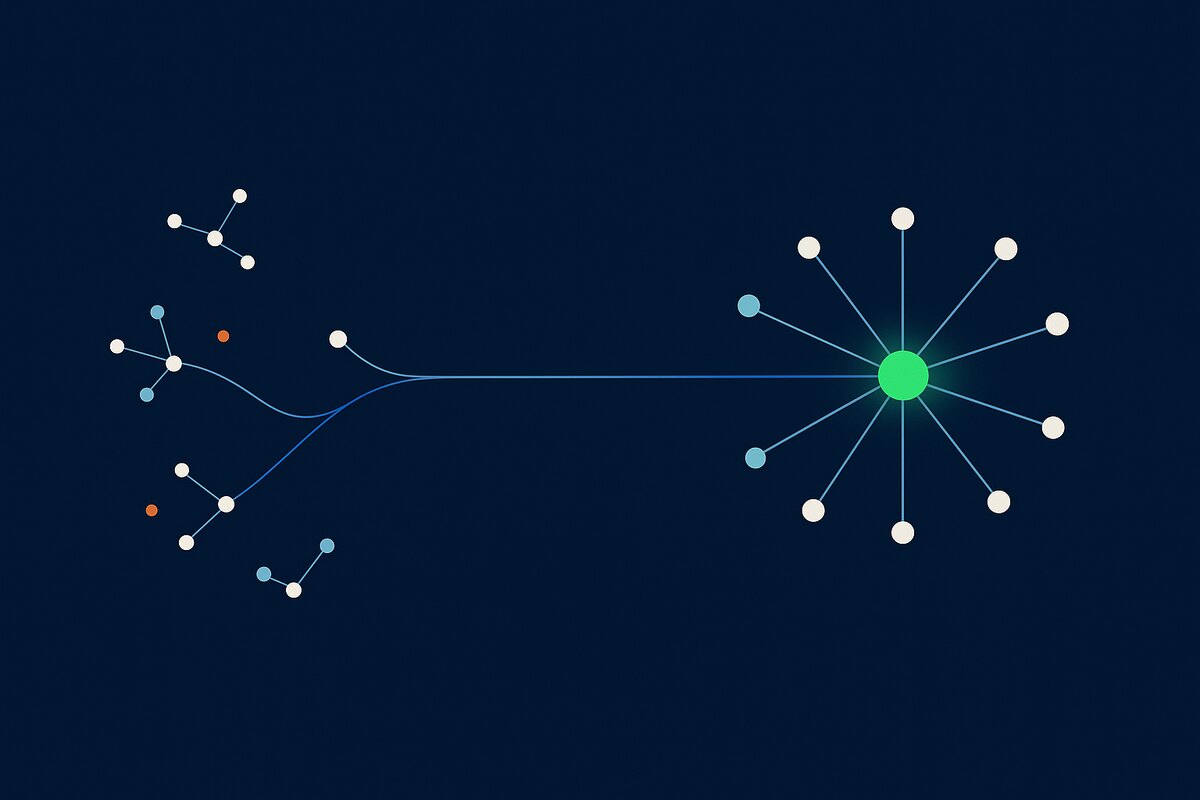
Not another chatbot. We map how your business actually works, then automate and integrate it, so quality, compliance and output go up.
Today the same order gets retyped three times: in the webshop, in the spreadsheet, and in the system that prints the invoice. Nobody planned it that way. It grew. The cost is invisible because it is spread across everyone’s day.
Afterwards, work flows through one system, the numbers are on your phone, and the audit is a printout rather than a panic.
Standardize, then automate
The order matters. Automating a process nobody agrees on just makes the disagreement faster. So we start by writing down how the work actually runs today, including the parts that only live in someone’s head, and settle what the standard version is. Then we automate that.
How the work is staged
- Discovery call. Free, no obligation. We find out whether there is a problem worth solving and whether we are the right people for it.
- Solution Proposal. A two-week process survey at a price fixed before we start. Two to three workshops, roughly three hours of your team’s time. You get a map of how work really flows, a list of the leaks with a number against each, a roadmap, and a fixed quote for the build.
- Build. One process digitised, fixed price, quoted only after the survey has shown where the value is.
- Integrate. Enterprise systems talking to each other with an audit trail, entered through a paid pilot.
- Care. Every delivery has a maintenance line. Software that nobody maintains becomes the next legacy problem.
We do not quote a build without a survey first. A number produced before anyone has looked at the process is a guess, and guesses are what make automation projects overrun.
What you keep either way
The map, the quantified leak list and the fixed quote are yours whether or not you continue with us. If the survey finds the problem is smaller than expected, or is somebody else’s to solve, that is a useful outcome and you still have the document.
Who this is for
Owners and operations managers at small and medium companies where the same information is entered more than once. Organizations facing an audit or a compliance requirement that their current process cannot evidence. Teams whose growth is limited by coordination rather than demand.