
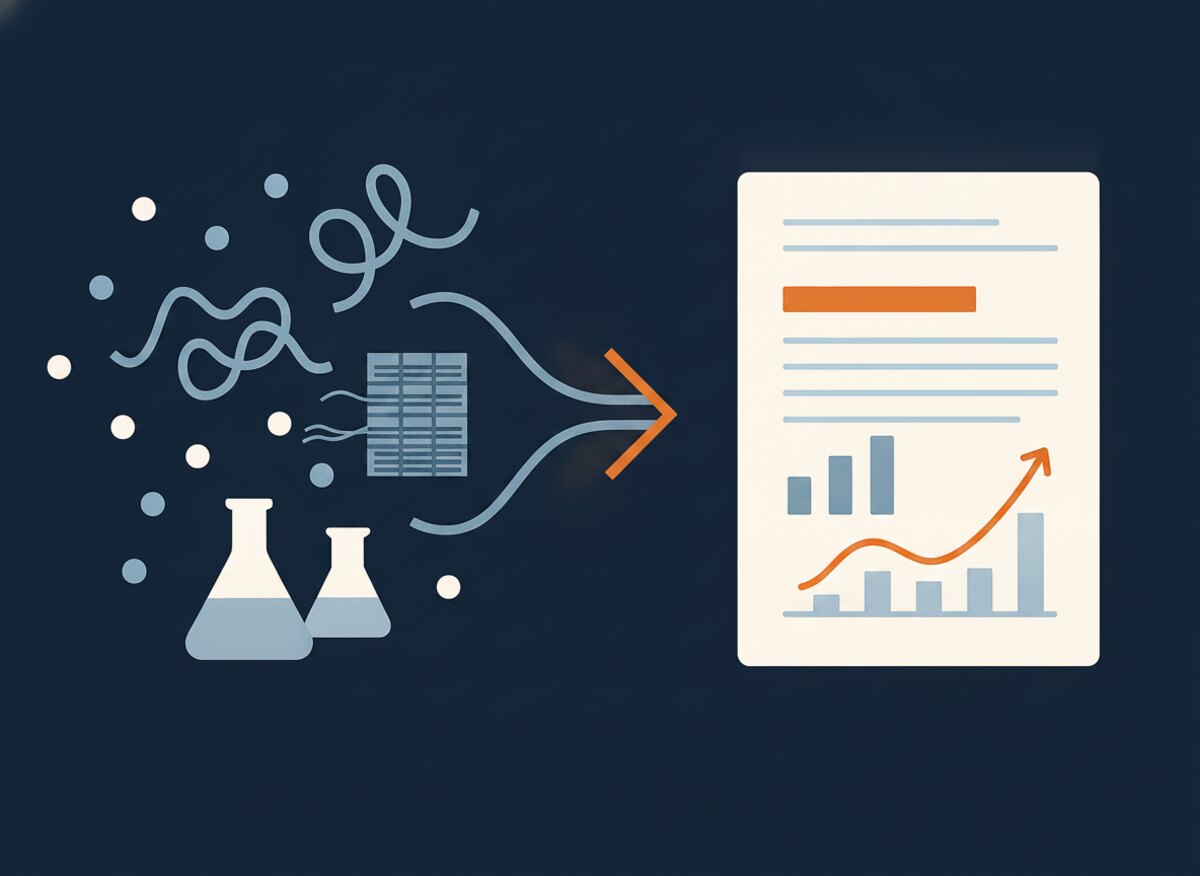
Turn complex biomedical and research data into results you can publish, ship and defend.
Discovery is what we call the work of getting from data to a defensible answer. Not discovery in the drug-hunting sense, and not analytics in the dashboard sense. It is the stretch between having measurements and having something you would put your name on: the analysis, the method that survives a reviewer, and the code that still runs next year.
We work with research groups, hospitals and life-science companies that have more data than analysis capacity. Some have no bioinformatician at all. Others have one and need a second pair of hands for a specific study.
What you get
- A reproducible analysis. Pipelines with pinned versions, documented parameters and a run log, so the same input gives the same output next year.
- Figures and tables built for publication. Drawn to journal requirements, with the underlying data and the code that produced them.
- Methods text you can submit. A written description of what was done and why, in enough detail for a reviewer to follow.
- The code, and the training to run it. We hand over the repository and walk your team through it, so the work does not stop when the engagement does.
What we work with
Next-generation sequencing (NGS) and human genome variant analysis, transcriptomics, and nuclear magnetic resonance (NMR) based metabolomics. We run these on high-performance computing (HPC) clusters and on graphics processing units (GPUs) where the workload justifies it, using the standard toolchain of the field alongside our own workflows in Python, R and Bash.
Where an off-the-shelf tool does not fit, we build custom analysis software to a fixed scope, so the method matches the question rather than the other way round.
How we work
- Scope before data moves. We agree what question the study answers, what would count as an answer, and whether the data on hand can support it. This is where most problems are cheapest to fix.
- Design review. Cohort definition, batch effects, confounders, the analysis plan and the statistics behind it.
- Analysis. Quality control, the pipeline itself, interpretation and the write-up. You see intermediate results as they come, not only at the end.
- Handover. Code, documentation and a walkthrough, so your group can re-run and extend the work.
Who this is for
Principal investigators and research groups with a grant deadline and a data backlog. Clinical departments moving a sequencing assay toward routine use. Companies whose product generates biological data faster than their team can interpret it.