
Project Description
-
Conducted an in-depth microbiological analysis of activated sludge in a full-scale EBPR (Enhanced Biological Phosphorus Removal) wastewater treatment plant.
-
Identified key glucose-fermenting bacteria using advanced RNA-based stable isotope probing (RNA-SIP).
-
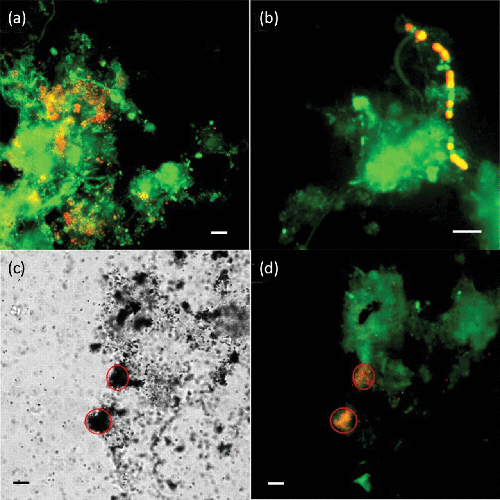
Designed and applied specific FISH probes to precisely detect and visualize target fermenting bacteria.
-
Confirmed the dominant role of Tetrasphaera, Propionicimonas, and Streptococcus in anaerobic glucose fermentation.
-
Quantified their abundance across 10 full-scale EBPR plants, showing they make up an average of 39% of total microbial biomass.
-
Provided critical insight into the importance of fermenting bacteria in supporting phosphorus removal, enabling better control and optimization of EBPR performance.
Project Details
Results
-
All WWTPs studied had stable nitrogen and phosphorus removal at the time of sampling.
-
SIP experiments confirmed glucose fermentation kinetics in Aalborg East WWTP, at 0.122 ± 0.027 mmol glucose/(g VSS)/h.
-
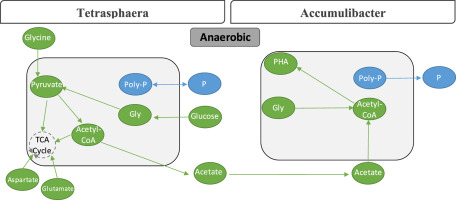
Glucose was fermented into SCFAs: formic, acetic, propionic, butyric, and lactic acids.
-
RNA-SIP revealed active uptake of 13C-labeled glucose, with effective RNA extraction and clear density gradients separating labeled RNA.
-
Phylogenetic analysis of labeled RNA identified major groups: Firmicutes, Actinobacteria, and Proteobacteria.
-
Designed specific FISH probes for Lactococcus, Propionicimonas, and Streptococcus; optimized across 10 full-scale WWTPs.
-
MAR-FISH confirmed that all FISH-positive bacteria from these genera actively fermented glucose.
-
Incubation with glucose did not alter microbial composition, confirming probe stability and specificity.
-
Most fermenting bacteria were Firmicutes and Actinobacteria, with Tetrasphaera, Propionicimonas, and Streptococcus as key fermenters.
-
Quantification across 10 WWTPs showed:
-
Tetrasphaera: up to 44% of total biovolume (avg. 33%)
-
Propionicimonas: present in all plants (avg. 4–5%)
-
Streptococcus & Lactococcus: generally low abundance (mostly <1%)
-
-
Tetrasphaera clades 1–3 were all capable of anaerobic glucose fermentation, confirmed by MAR-FISH.
-
The new FISH probes identified ~85% of all glucose-fermenting bacteria in the samples.
Goals Achivied
The study successfully achieved its initial objectives:
-
Identified key glucose-fermenting bacteria in activated sludge using rRNA-based Stable Isotope Probing (SIP) and validated their physiology with MAR-FISH.
-
Confirmed the in situ fermentation ability of Tetrasphaera, Streptococcus, and newly identified Propionicimonas as dominant glucose fermenters.
-
Quantified the fermenters’ abundance, revealing they comprise up to 38.9 ± 7% of total bacterial biovolume across 10 full-scale EBPR wastewater treatment plants.
-
Demonstrated the functional diversity of fermenters, most of which are facultative and belong to the phyla Actinobacteria and Firmicutes.
-
Revealed new functional roles for known and previously unassociated genera (e.g. Propionicimonas, Lactococcus, Tolumonas, and Burkholderia) in glucose fermentation.
-
Designed and validated new FISH probes for accurate detection and quantification of fermenting populations in situ.
-
Highlighted the ecological and operational importance of fermentation, showing it as a widespread and significant process in activated sludge systems.
-
Provided actionable insight into improving biological N and P removal through better understanding and monitoring of fermenter communities.
Explore the full research here