
Project Description
-
Investigated Staphylococcus aureus gene expression and metabolism in a prosthetic joint infection with acute presentation.
-
Combined deep RNA sequencing and NMR-based metabolomics to study the bacterial transcriptome and joint fluid metabolome in vivo.
-
Compared in vivo findings with S. aureus grown in vitro to highlight differences in gene expression and metabolism.
-
Found high expression of siderophore synthesis and virulence genes, indicating active infection.
-
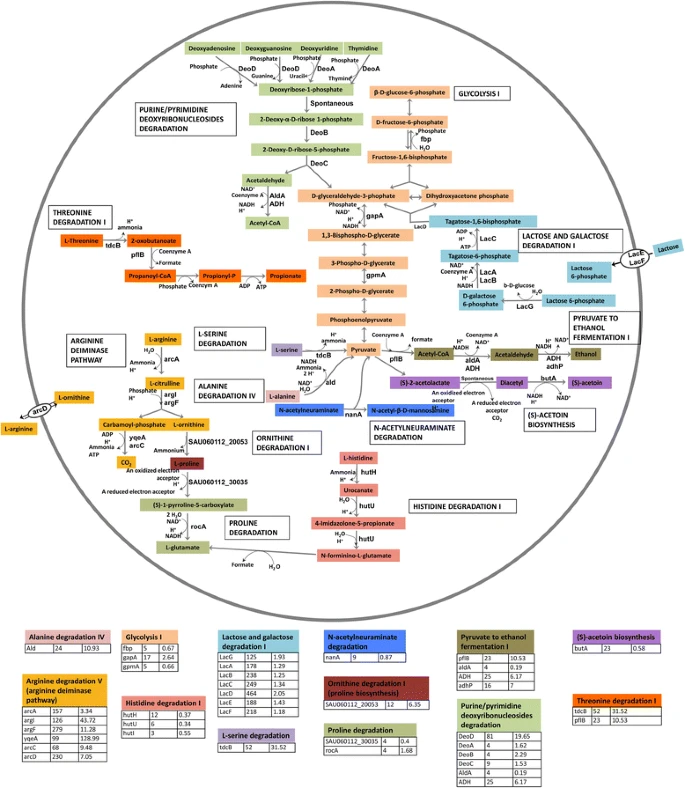
Identified that bacteria were sustained by amino acids, glycans, and nucleosides, not sugars or lipids.
-
Detected ethanol and upregulated fermentation genes, suggesting severe oxygen limitation in the joint environment.
-
Demonstrated how combined transcriptomic and metabolomic analysis can uncover mechanisms behind hard-to-diagnose prosthetic infections.
Project Details
Results
-
Successfully isolated and cultured a pure Staphylococcus aureus strain from an infected joint prosthesis using standard methods and amplicon sequencing.
-
Performed whole-genome sequencing, generating 17.8 million reads, yielding a high-quality draft genome with 2562 protein-coding genes.
-
Identified the isolate as spa type t908 and Clonal Complex 45 (CC45), genetically related to the USA600-BAA1754 strain.
-
Conducted RNA-seq analysis comparing in vivo and in vitro conditions, with 350 million reads from infected joint fluid and 430 differentially expressed genes (317 upregulated, 113 downregulated).
-
Detected significant upregulation of virulence genes in vivo, including γ-hemolysins (up to 776-fold), adhesins, and immune evasion molecules.
-
Notably high expression of regulatory systems saeRS and vraSR, known to control virulence and cell wall synthesis, likely induced by β-lactam antibiotic treatment.
-
Genome analysis confirmed pansusceptibility to major antibiotics, with no resistance genes detected for β-lactams, macrolides, or aminoglycosides.
-
Observed increased expression of efflux pumps and cell wall biosynthesis genes, possibly as a response to antibiotic stress.
-
In vivo gene expression revealed adaptation to hypoxic conditions, with strong activation of fermentation and arginine catabolism pathways (e.g., ADI pathway up to 279-fold).
-
Detected upregulation of iron acquisition genes, specifically the staphyloferrin B biosynthesis operon, supporting bacterial survival in iron-limited environments.
-
Revealed that free amino acids, nucleosides, and host-derived glycans were likely key nutrient sources for S. aureus in vivo.
-
Contrary to expectations, most hydrolytic enzyme genes were not expressed in vivo, suggesting nutrient liberation may have been driven by host inflammatory enzymes rather than bacterial secretion.
Goals Achivied
-
Collected and analyzed Staphylococcus aureus directly from infected joint aspirates of human patients.
-
Successfully re-isolated the same bacterial strains for in vitro comparison.
-
Performed integrated transcriptomic and metabolomic profiling of in vivo vs. in vitro bacterial states.
-
Identified key differences in glucose utilization and energy metabolism in the host environment.
-
Revealed suppressed expression of nitric oxide detoxification genes in vivo, suggesting immune evasion strategies.
-
Detected altered amino acid uptake patterns, reflecting host-induced metabolic stress.
-
Provided the first systems-level insight into how S. aureus adapts transcriptionally and metabolically during acute prosthetic joint infection.
-
Validated the importance of studying pathogens in clinically relevant, in vivo-like conditions.
Explore the full research here